Sistema de Informação Rui Goes Ferreira
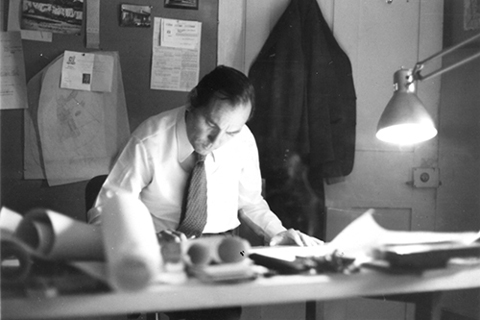
Rui Goes Ferreira no seu atelier de arquitectura, s.d., s.a.
"A sua obra arquitetónica, ainda pouco conhecida, representa a perseguição do desenho, o contínuo apuramento do traço ao longo do tempo, na adequação a situações de projeto sempre diferentes. Seguir os passos de Rui Goes Ferreira é uma desconcertante experiência de humanidade, de limite, de procura insaciável, de sonho e de utopia."
Duarte Belo
Rui Goes Ferreira nasceu no Funchal a 8 de novembro de 1926. Formou-se em arquitetura no Porto, cidade onde frequenta a Escola de Belas Artes e inicia o exercício da prática da Arquitetura como estagiário no atelier de Januário Godinho. Regressou à Madeira em 1955, aí desenvolvendo uma intensa e diversificada atividade enquanto profissional liberal, professor e dinamizador de projetos culturais. É no território natal que a sua obra vai ganhar plena expressão. Atento ao lugar, ao seu contexto urbano e paisagístico, projeta em sintonia com os princípios modelares de uma formação moderna, mas sensível às preocupações e necessidades de uma comunidade com um caráter singular.
Precursor da arquitetura moderna no arquipélago da Madeira, Rui Goes Ferreira, a par de Raúl Chorão Ramalho, revela diferentes campos de atuação e de interesse: Arquitetura, Urbanismo, Arte e Sociedade. Pelo seu atelier passaram nomes como Manuel Vicente, Marcelo Costa, José António Paradela, José Zúquete ou António Marques Miguel. Da obra realizada, destaca-se o trabalho realizado no Funchal para as Habitações Económicas da Federação das Caixas de Previdência, com a colaboração de Bartolomeu Costa Cabral, vários projetos de unidades de habitação individual e coletiva, como o Bairro dos Pescadores em Câmara de Lobos, o arranjo e proposta de construção de um abrigo para o Miradouro do Pico do Areeiro, o acompanhamento do Plano Diretor da Cidade do Funchal, coordenado por José Rafael Botelho, ou o projeto cultural da Galeria de Artes Decorativas TEMPO, desenvolvido com o escultor Amândio Sousa.
Duas das suas obras, a Casa do Povo da Boaventura, em São Vicente, edifício que conjuga exemplarmente as condicionantes locais da Ilha da Madeira com a linguagem moderna, e a Fábrica da Empresa de Cervejas da Madeira, projecto que alcança a circunstância rara de atribuir urbanidade a um programa eminentemente industrial, foram recentemente propostas para Classificação como Conjuntos de Interesse Público.
Em 2018, a sua obra foi objecto da exposição “Rui Goes Ferreira. Imagem de uma obra interrompida”, com curadoria de Madalena Vidigal, neta do arquitecto, e fotografias de Duarte Belo. Na dissertação de mestrado que dedicou à obra do avô, Madalena Vidigal refere que Goes Ferreira "levou para a Madeira a reflexão do papel social do arquiteto. Um trabalho feito pelo homem para o homem que usa a paisagem e o lugar como dado cultural a integrar na estrutura final, humanizando a arquitetura e desenhando-a à escala natural".
A recente transferência do espólio deste arquiteto, prematuramente falecido em 1978, para a Fundação Marques da Silva vai possibilitar novas aproximações ao seu legado, criando um contexto favorável à realização de ações que promovam o conhecimento e estudo de uma arquitetura que ainda hoje marca o território onde foi construída. Trata-se da memória documental do trabalho desenvolvido no atelier de Rui Goes Ferreira ao longo de mais de 20 anos de atividade, testemunhada em cerca de 90 projetos que passam a estar disponíveis para investigação.
Consultar:
Arquivo Digital FIMS
Sobre este Arquiteto:
Madalena Vidigal,“Rui Goes Ferreira: Ensaios sobre uma obra interrompida. Madeira 1956-1978”, Dissertação de Mestrado, Faculdade de Arquitecctura da Universidade do Porto, 2016.
Exposição RUI GOES FERREIRA.Imagem de uma obra interrompida (Porta 33, Funchal, 2018)
Mapa de Arquitetura, lançado a 4 de outubro de 2022, pela Secção Regional da Ordem dos Arquitetos, com o apoio da Fundação Marques da Silva e da Secretaria Regional e de Turismo da Madeira. Conceção e organização de conteúdos por Madalena Vidigal.
Exposição O Atlas do Planeamento, uma iniciativa da Secretaria Regional de Agricultura e Ambiente, através da Direcção Regional do Ordenamento do Território, que contou com o apoio da Fundação Marques da Silva, Madeira (2024).